
S. Bear Bergman is exhausted by the language of "feminine hygiene products.” So much so that he carries a Sharpie with him so he can edit labels and write in “menstrual products” instead. His children are, by Bergman’s own account, thoroughly tired of this. But Bergman, an educator and storyteller based in Regina, is willing to accept the eye-rolls. “I object to the euphemisms,” he says.
It’s a small act of correction, but it points to something larger: the language around periods still assumes a single kind of body. A 2024 study of U.S. public schools found that only a quarter of health education programs included menstruation – and where it does appear, it is almost always framed as a girls-only narrative: a rite of passage into womanhood, a monthly hassle, a biological milestone that begins in adolescence and ends at menopause. Marketing has reinforced that script with pink packaging, soft-focus advertising, and the ubiquitous “feminine hygiene” signage. The message is singular: periods belong to women, and they happen one particular way.
In reality, cycles differ widely even for those who share a body part or demographic category. Conditions like PMOS (formerly PCOS), endometriosis, perimenopause, and postpartum changes mean that the idea of “a normal period” is fiction. For gender-diverse people, the relationship to a cycling body is even more complex.
“Guys get periods too,” says Dreamer Isioma, a Gen Z musician and artist based in Chicago.
While many trans men and non-binary people opt for gender-affirming hormone therapy, surveys of transmasculine people suggest that roughly one in five have not used testosterone, whether because of access barriers, health considerations, personal choice, or other reasons. “You don’t have to physically transition or take hormones or have surgery to feel how you feel on the inside,” Isioma says.
Even for those like Isioma who take testosterone, which typically stops periods within months, breakthrough bleeding can happen. “It caught me off guard that if you miss shots, your cycle can come back,” he says. “I literally bled through some of my favourite shorts the other day. I was so mad. But you just have to give yourself grace and understand your body is doing its thing. It’s not a bad thing. It’s just a natural cycle.”
Finding products that work for your body is an important part of self-care – and the options have come a long way, thanks in part to decades of work by queer and feminist communities pushing for menstrual equity. “In university I met a lot of radical feminists and I distinctly remember a workshop with a very detailed demonstration of how to use an applicator-free tampon,” Bergman, now in his 50s, recalls. “Not long after that I learned about menstrual cups from Dykes to Watch Out For, the comic strip by Alison Bechdel.”
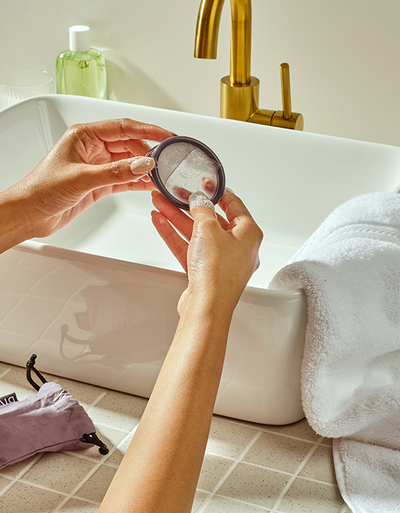
In the decades since, the market has expanded considerably. “There’s an awareness that different people need different things,” Berman says. Cups, discs, period underwear, reusable pads, and absorbent boxer briefs now sit alongside conventional products. And queer menstruators describe the right tools as more than just functional – they can also be affirming.
"For me, it’s black underwear, black everything!" says Isioma. "Exercise has also helped with cramps, and it helps me feel more like myself. Lately I've been really into kickboxing, yoga, and lifting weights. Managing my symptoms means staying active, taking vitamins, and generally trying to be healthy."
Self-care often has to make up for real shortcomings in health care systems, which have been slow to recognize the needs of gender-diverse patients, leading to critical gaps in care. For example, trans and non-binary menstruators consistently report invalidating experiences because reproductive and gynecological care is not designed with them in mind, and many encounter providers who lack training in gender-affirming practice.
“You’re often going to know more than some doctors do,” says Gabe Dunn, a 38-year-old trans writer living in Los Angeles. “Sometimes the first question at the gynecologist is essentially, ‘Why are you here?’ And even when I was getting top surgery, my surgeon was awkward about pronouns.”
Research has found that nearly half of trans patients reported at least one negative experience with a provider in the past year, and many describe being approached with rigid expectations about how they are supposed to look, feel, and behave. Those same expectations show up beyond the exam room, including in how trans people are sometimes asked to prove their own identities.
Bergman is emphatic on this point: “How you feel about your period doesn't determine your gender. People sometimes treat gender dysphoria like a checklist and they get stuck there, thinking that if menstruation isn't the worst thing that ever happened to them, then maybe they're not really trans. That's nonsense.” While many trans people find menstruation deeply distressing, others experience it neutrally or even, in some cases, with appreciation. “Your relationship to menstruation may be connected to your gender, but it doesn't have to be. Your gender identity is valid regardless,” Bergman says.
That kind of reframing is helping to shift the broader culture. Gender-diverse creators have built substantial online communities. And visibility in popular media is more common, largely because trans people have done the work of telling their own stories, even when it means pushing against a more dominant narrative.
“A lot of trans people make themselves smaller because they don’t want to cause problems,” Dunn says. “But if someone says something that erases your experience, it’s okay to correct them. You’re helping people learn. You’re expanding how people think.”
The point isn’t to replace one narrow story about menstruation with another. It’s to recognize the vast expanse of realities that have always existed but were rarely acknowledged: trans men who menstruate, non-binary people whose cycles have stopped, people whose periods never followed expected patterns. These are not exceptions to the story, they are part of it.
DIVA believes conscious cycle care is for every body. And the more we move beyond the idea of a single “right” way to have a period – in classrooms and clinics and conversations – the more room we make for people to see themselves in that story.